Choosing the right siding for your home is one of the most consequential exterior decisions you’ll make. The material you select affects your home’s appearance, energy efficiency, maintenance demands, and how well it holds up through decades of weather. For homeowners across Pennsylvania, Maryland, Connecticut, and New Jersey, that weather includes harsh winters, nor’easters, freeze-thaw cycles, coastal humidity, and punishing summer heat, conditions that test every siding material differently.
The Exterior Company, the four-state region’s trusted partner for exterior home improvement, has installed every major siding type on homes throughout the Northeast and Mid-Atlantic. This guide is designed to give you a clear, honest picture of your options so you can make the right call for your home, your budget, and your long-term goals.
Not sure which siding is right for your home? Contact The Exterior Company for a free consultation and expert recommendation.
What to Consider Before Choosing a Siding Type
Before comparing specific materials, it helps to think through the factors that will shape your decision. The “best” siding isn’t universal, it’s the one that fits your specific situation. Here are the key questions to work through:
How long do you plan to stay in the home? If you’re planning to sell within a few years, ROI and curb appeal matter most. If you’re staying for decades, long-term durability and low maintenance costs deserve more weight.
What is your maintenance tolerance? Some siding materials, particularly natural wood, require regular painting, caulking, and inspection to stay in good condition. Others, like vinyl, need little beyond occasional cleaning.
What does your home’s architecture call for? A Victorian-era home in Lancaster’s historic district has different aesthetic needs than a mid-century ranch in suburban New Jersey. Material and profile choices should honor your home’s original character.
What is your climate exposure? Homes on the Connecticut coast face different stresses than homes in inland Pennsylvania. Salt air, sustained wind, and moisture levels vary significantly across the four-state region.
What is your budget, for installation and over time? A lower upfront cost sometimes means higher long-term maintenance expenses. The total cost of ownership over 20 to 30 years is the more meaningful number.
Vinyl Siding
What It Is
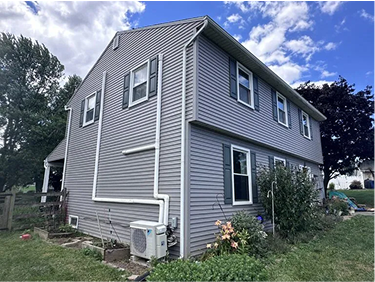
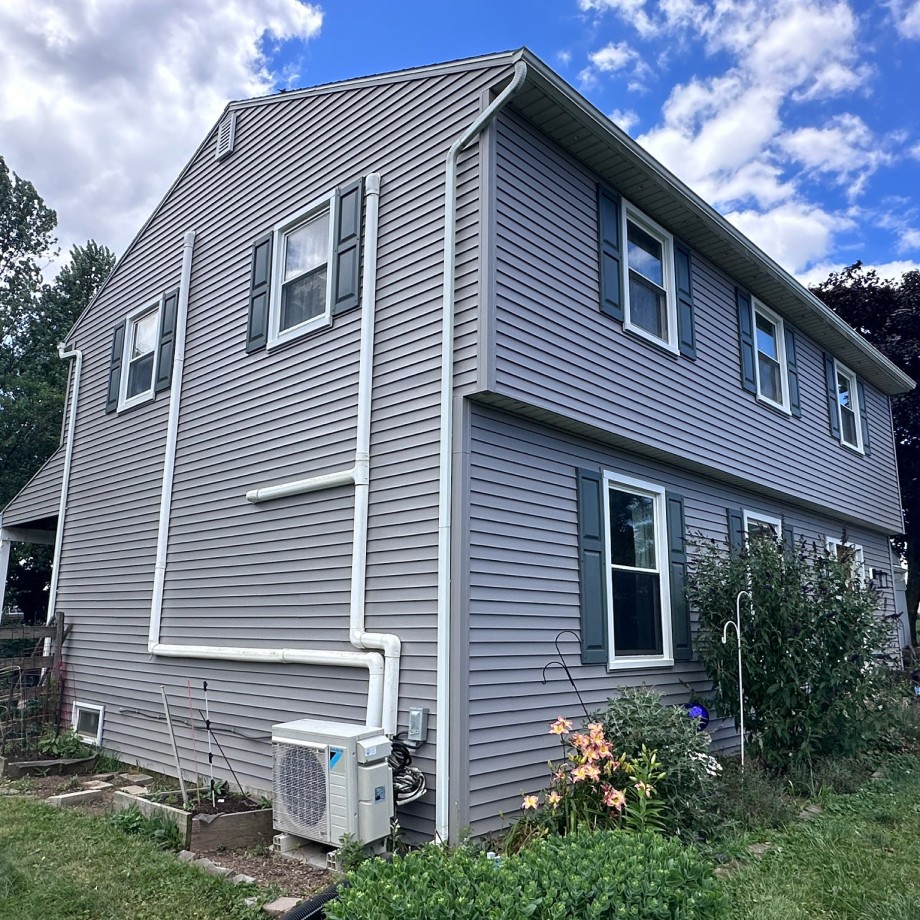
Vinyl siding is made from polyvinyl chloride (PVC) and is the most widely installed siding product in the United States. It comes in a broad range of profiles — horizontal lap, dutch lap, board-and-batten, beaded, and shake styles — and in hundreds of colors, most with fade-resistant finishes baked into the material rather than applied as a surface coat.
Performance in the Northeast and Mid-Atlantic
Modern vinyl siding is a significant improvement over the products installed on homes 25 to 30 years ago. Today’s premium vinyl is thicker, more impact-resistant, and better engineered for dimensional stability through temperature swings. Proper installation, with the correct fastening and spacing to allow thermal expansion, is critical to long-term performance in climates with wide seasonal temperature ranges like Pennsylvania and New Jersey.
Vinyl does have limitations in extreme cold. At very low temperatures, it can become brittle and more susceptible to impact damage. Premium-grade products from reputable manufacturers perform meaningfully better than budget options in this regard.
Pros and Cons
Pros: Low cost, minimal maintenance, wide color and profile selection, moisture-resistant, no painting required
Cons: Can crack in extreme cold, less dimensional rigidity than fiber cement, visible as vinyl at close range, color cannot be changed without replacement
Lifespan: 20 to 40 years with proper installation and maintenance
Maintenancelevel: Low, periodic cleaning with a garden hose or soft brush
Fiber Cement Siding
What It Is
Fiber cement siding is manufactured from a mixture of cement, sand, and cellulose wood fibers pressed into panels. The result is a dense, dimensionally stable product that resists moisture, insects, rot, and fire. It can be manufactured to convincingly replicate the look of natural wood lap siding, wood shingles, or vertical board siding, and it accepts paint exceptionally well, either factory-applied or field-applied.
Performance in the Northeast and Mid-Atlantic
Fiber cement is an excellent performer in the Northeast and Mid-Atlantic climate. Its density and dimensional stability mean it doesn’t expand and contract as dramatically as vinyl through freeze-thaw cycles. It resists moisture infiltration more effectively than wood and holds paint far longer, reducing the frequency of repainting over the life of the product. It’s also non-combustible, which matters in areas prone to wildfire risk or for homeowners seeking better fire resistance.
The main practical consideration is weight. Fiber cement is significantly heavier than vinyl, which affects shipping, handling, and the physical demands of installation. Professional installation by experienced crews, like those at The Exterior Company, is essential to a quality outcome.
Pros and Cons
Pros: Exceptional durability, rot and insect resistant, fire resistant, holds paint well, high-end appearance, strong resale value
Cons: Higher upfront cost than vinyl, requires periodic repainting, heavier material requiring professional installation
Lifespan: 30 to 50 years with proper maintenance
Maintenancelevel: Moderate, repainting every 10 to 15 years, annual inspection of caulk and paint
James Hardie Siding
What It Is
James Hardie is the leading manufacturer of fiber cement siding products and deserves its own section because of how widely it is specified, requested, and recognized by homeowners across the Northeast. The James Hardie product line includes HardiePlank lap siding, HardiePanel vertical siding, HardieShingle individual shingles, and HardieSoffit, a complete exterior cladding system from a single manufacturer.
The HardieZone Advantage
What sets James Hardie apart from generic fiber cement products is the HardieZone system. James Hardie engineers its products for specific climate zones rather than manufacturing one product for all regions. The HZ5 product line, designed for the Northeast and Mid-Atlantic, including Pennsylvania, New Jersey, Maryland, and Connecticut, is engineered to handle the freeze-thaw cycles, temperature extremes, and humidity conditions characteristic of this region. Homeowners who choose James Hardie aren’t just buying fiber cement, they’re buying fiber cement built for where they live.
ColorPlus Technology
James Hardie’s factory-applied ColorPlus finish is baked on through a multi-coat process that produces a harder, more durable surface than field-applied paint. ColorPlus finishes come with a 15-year warranty against peeling, cracking, and chipping, a meaningful advantage over siding that requires full repainting within 5 to 10 years of installation.
Pros and Cons
Pros: Climate-zone engineered, industry-leading warranties, factory ColorPlus finish option, full product system from one manufacturer, exceptional long-term durability
Cons: Premium price point, requires professional installation, repainting eventually required on field-painted installations
Lifespan: 30 to 50+ years
Maintenancelevel: Low to moderate, ColorPlus finish extends repainting intervals significantly
Engineered Wood Siding
What It Is
Engineered wood siding — products like LP SmartSide — is manufactured from wood strands or fibers bonded with resins and binders under heat and pressure, then treated for moisture and pest resistance. The result is a product that closely replicates the appearance of natural wood grain while delivering significantly improved resistance to the moisture and insect challenges that make natural wood siding demanding to maintain.
Performance in the Northeast and Mid-Atlantic
Engineered wood performs well across the Northeast and Mid-Atlantic when properly installed with correct moisture management details. It’s lighter than fiber cement, making it easier to handle and install. It accepts paint well and can be refinished over time to update color. In humid coastal areas, like Connecticut’s shoreline communities or Maryland’s Chesapeake Bay region, proper installation with attention to sealing and flashing details is especially important to long-term performance.
Pros and Cons
Pros: Authentic wood appearance, lighter than fiber cement, accepts paint well, improved moisture resistance over natural wood, lower cost than fiber cement
Cons: Not as moisture-resistant as fiber cement, requires repainting, may require more attention to installation details in very humid or coastal environments
Lifespan: 20 to 30 years with proper maintenance
Maintenance level: Moderate — periodic repainting and inspection of seams and penetrations
Natural Wood Siding
What It Is
Natural wood siding — cedar, redwood, pine, and other species — is the traditional choice that all modern siding products attempt to replicate. It offers genuine warmth and character that no manufactured product fully matches, and it can be painted or stained in any color. Cedar is the most common species used for exterior siding due to its natural resistance to rot and insects.
Performance in the Northeast and Mid-Atlantic
Natural wood is the most maintenance-intensive siding option. It must be painted or stained and sealed regularly — typically every five to seven years — to prevent moisture infiltration, rot, and insect damage. In the Northeast’s climate, with its cycles of freezing, thawing, rain, and summer heat, untreated or poorly maintained wood siding deteriorates relatively quickly. For homeowners committed to the maintenance regimen, wood siding can last many decades. For those who aren’t, it becomes a recurring repair expense.
Pros and Cons
Pros: Authentic appearance, can be painted or stained any color, environmentally renewable material, excellent insulation properties
Cons: High maintenance demands, susceptible to rot and insects without consistent upkeep, higher long-term cost when maintenance is factored in
Lifespan: 20 to 40+ years with consistent maintenance; significantly less without it
Maintenancelevel: High — repainting or restaining every 5 to 7 years, regular inspection and caulking
Comparing Siding Types Side by Side
Here’s a quick-reference summary of how the most common siding types compare across the factors that matter most to Northeast and Mid-Atlantic homeowners:
Vinyl: Lowest upfront cost | Lowest maintenance | 20-40 year lifespan | Good weather resistance | Limited appearance options
James Hardie: Premium upfront cost | Low-to-moderate maintenance | 30-50+ year lifespan | Climate-zone engineered | Industry-leading warranties
Engineered Wood: Mid upfront cost | Moderate maintenance | 20-30 year lifespan | Good weather resistance | Authentic wood appearance
Natural Wood: Variable upfront cost | High maintenance | 20-40+ year lifespan (with upkeep) | Susceptible without consistent care | Unmatched authentic appearance
Which Siding Type Is Right for Your Home?
The right answer depends on your priorities. For most Northeast and Mid-Atlantic homeowners who want a balance of performance, durability, and reasonable cost, fiber cement — and James Hardie in particular — represents the strongest long-term value. For homeowners focused primarily on upfront cost and low maintenance, quality vinyl from a reputable manufacturer installed correctly is a reliable choice that will serve them well for decades.
Natural wood is the right choice for homeowners who genuinely love the material and are committed to its maintenance demands. Engineered wood offers a middle path for those who want the wood aesthetic with more forgiving performance characteristics.
The Exterior Company installs all of these products across Pennsylvania, Maryland, Connecticut, and New Jersey. Our job isn’t to sell you the most expensive option, it’s to help you choose the right one and install it correctly so it performs as it should for years to come.
Ready to choose the right siding for your home? Contact The Exterior Company for a free consultation and honest recommendation.
Is your home looking a little tired? It might be time for new siding. The Exterior Company in Lancaster County helps homeowners update their siding with products that look great, perform efficiently, and are built to last. Whether you’re dealing with the aftermath of storm damage, panels that have cracked in the sun, or colors you no longer like, we’re the team to trust for expert siding installation.
Siding doesn’t always fail dramatically. Here are some subtle signs you might be due for an update:
Cracks and warping: When siding starts to crack or buckle, you know it’s losing strength. The resulting gaps between the panels allow moisture to seep in, which can cause wood rot and mold growth.
Peeling interior paint: Moisture that sneaks through damaged siding often gets into your drywall, leading to bubbling, peeling, or flaking paint inside your home. First, make sure plumbing or roof leaks aren’t to blame. If you rule out these causes, peeling wall paint could mean your siding isn’t doing its job.
Mold growth: Dark streaks or fuzzy growth on your siding indicates moisture infiltration. Mold is a health hazard you should take seriously.
Faded color: Siding that has faded after years of sun exposure may be UV-damaged. This means the material has broken down and no longer protects your home as effectively as it should.
Frequent repairs: If you’re constantly fixing cracks, repainting, or dealing with rot, eventually it will be more cost-effective to replace the siding altogether.
Frequently Asked Questions About Home Siding Types
Is James Hardie worth the extra cost over standard fiber cement?
For most Northeast and Mid-Atlantic homeowners, yes. The HardieZone climate engineering, ColorPlus factory finish, and comprehensive warranty structure provide meaningful advantages that justify the premium over generic fiber cement products, particularly if you plan to stay in the home long-term.
Can I paint vinyl siding a different color?
You can paint vinyl siding, but it’s not straightforward. Vinyl expands and contracts significantly with temperature changes, which causes many paints to peel over time. You’re also limited to colors no darker than the original, since darker colors absorb more heat and can cause the panels to warp. Replacement is often the more practical choice when a color change is desired.
How do I know if my home’s existing siding is fiber cement or vinyl?
Tap it. Vinyl is hollow-sounding and slightly flexible. Fiber cement sounds solid and doesn’t flex. Fiber cement is also significantly heavier — you can often feel the difference at an exposed edge or corner. The Exterior Company can identify your existing material during a free inspection.
Which siding type holds up best in coastal areas of New Jersey and Connecticut?
Fiber cement and James Hardie products perform best in coastal environments because they are impervious to salt air corrosion and moisture infiltration. Engineered wood can perform well with careful installation and maintenance. Vinyl is generally acceptable but may show accelerated fading with sustained UV and salt air exposure.
When it comes to protecting your home’s exterior, experience and attention to detail make all the difference. The Exterior Company has helped homeowners across four states choose and install the right siding for their homes, and we’re ready to help you do the same. Contact us today for your free consultation.
Protect your home from the elements, contact The Exterior Company for a free exterior consultation today.
Regular roof maintenance and inspections can help identify weak spots before storms strike, reducing the risk of extensive damage. Timely roof repairs and upgrades enhance a roof’s resilience against future storms, ensuring the safety and protection of the entire residential structure.
As your local roofers, we recommend being proactive and having an expert from The Exterior Company assess your roof for free! Our team of experts will evaluate the condition of your home and help you with the next steps toward a new roof, siding, or gutters.